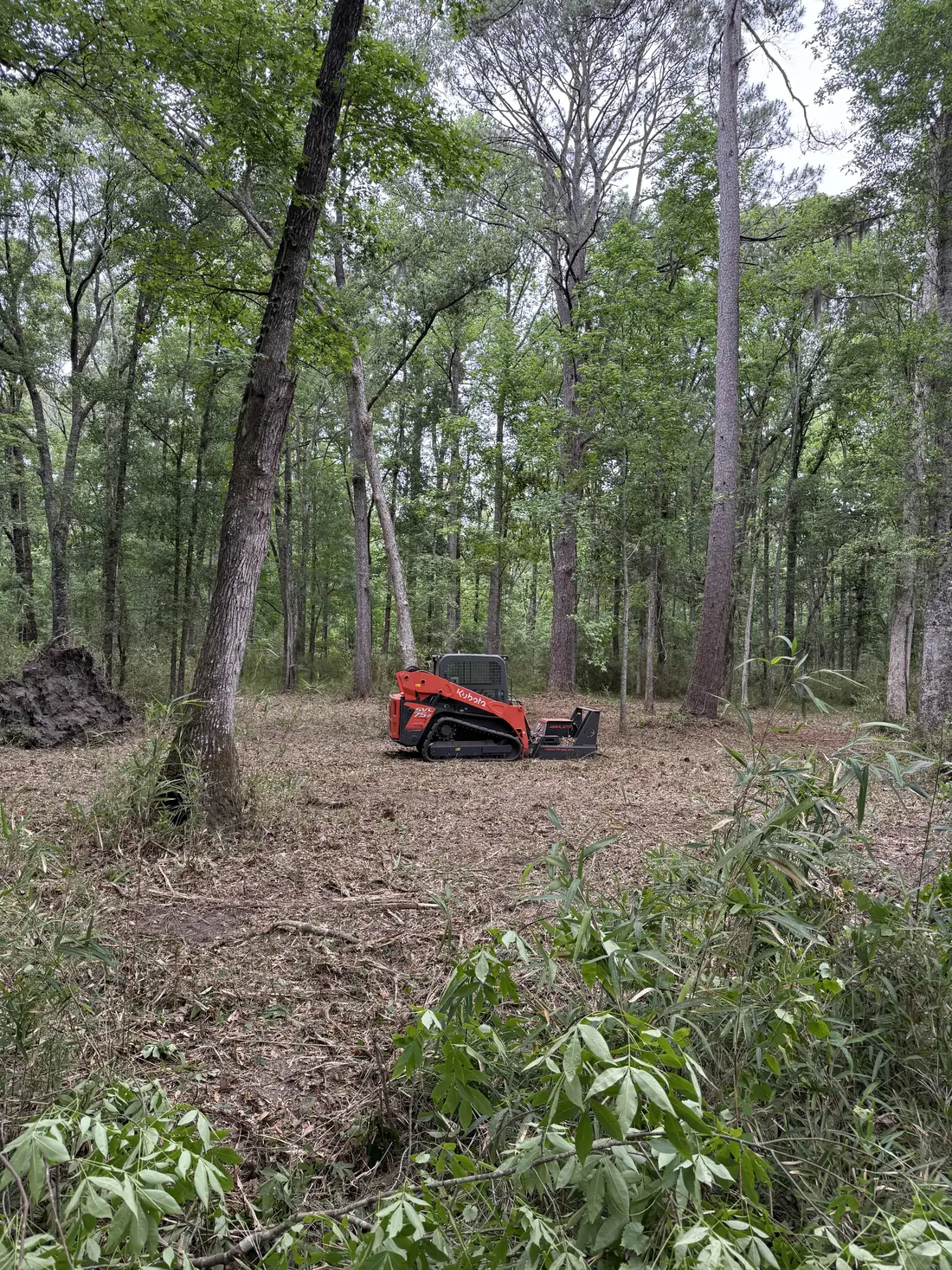
How much does forestry mulching cost in South Carolina?
Forestry mulching in South Carolina typically runs $600 to $2,500 per acre, with day rates of $1,500 to $3,000 for a machine and operator. Density decides where you land: thin understory under planted pine sits at the bottom, and a solid wall of wax myrtle and sweetgum climbs toward the top. Southeast pricing generally runs 10 to 20 percent below national averages.
Those are current market ranges from published 2026 guides, not our rate card. Our forestry mulching quotes come from walking the actual tract, zone by zone, but the numbers below will put your budget in honest territory before a machine ever loads.
What do the published 2026 ranges look like?
| Pricing model | Typical 2026 range | Where it applies |
|---|---|---|
| Per acre, light growth | $600 – $1,200 | Thin understory, saplings, first-year woody growth |
| Per acre, moderate | $1,000 – $2,500 | Closed understory, mixed brush, stems to ~5” |
| Per acre, dense | $2,500 – $4,000 | Interlocked thicket, heavy stems, tough access |
| Per machine day | $1,500 – $3,000 | Mixed density, phased big-tract work |
| Small-parcel minimum | Job-priced | Mobilization costs the same regardless of acres |
The spread is honest because “an acre” says nothing about the work. Lowcountry growth runs fast and thick - myrtle closes a cutover in a few seasons, sweetgum volunteers by the thousand, and smilax stitches it all together - so the walk-through, not the tax map, sets the real number.
What actually moves a Lowcountry mulching quote?
Density first, stem size second, access third. Stems up to about five inches feed straight through a mulching head; bigger wood takes longer or needs handling. Access matters on our ground in a particular way: wet lines. A tract with firm sand ridges works fast, while one where the machine must pick its way around bottoms works slower, and the honest quote reads the water on the walk-through rather than discovering it on your invoice.
The quiet factor is what stays. Selective work - grinding the understory while working around every keeper oak and pine - takes more care than flattening everything, and it is the way most Lowcountry landowners actually want their ground treated. We price it plainly because it is most of what we do, on clients’ land and on our own.
Why is mulching usually the cheaper path here?
Because the debris never leaves. Conventional clearing pays to pile, burn, or truck out everything that grew; mulching turns it into ground cover on the spot. No burn permits, no smoke over the neighbors, no convoy of debris trucks, and no bare dirt bleeding into a blackwater creek on the first summer storm - which on ACE Basin country is not a small point.
Full land clearing still has its place when a build needs bare, rooted-out dirt. The honest comparison is scope for scope, and we wrote up the whole decision in mulching vs. traditional clearing if your project sits on that line.
How do you get a real number for your tract?
Walk it with somebody who will write the quote down. Ours prices the tract zone by zone - what is thin, what is thick, what stays, what goes - so you can phase the work or take it all at once with no mystery in the number. The walk-through and the written estimate are free, and the number holds unless the scope itself changes.
Call or text (843) 696-7162, or start at the contact page. We work the whole Lowcountry from the ACE Basin, and the machine has seen every kind of thick this country grows.