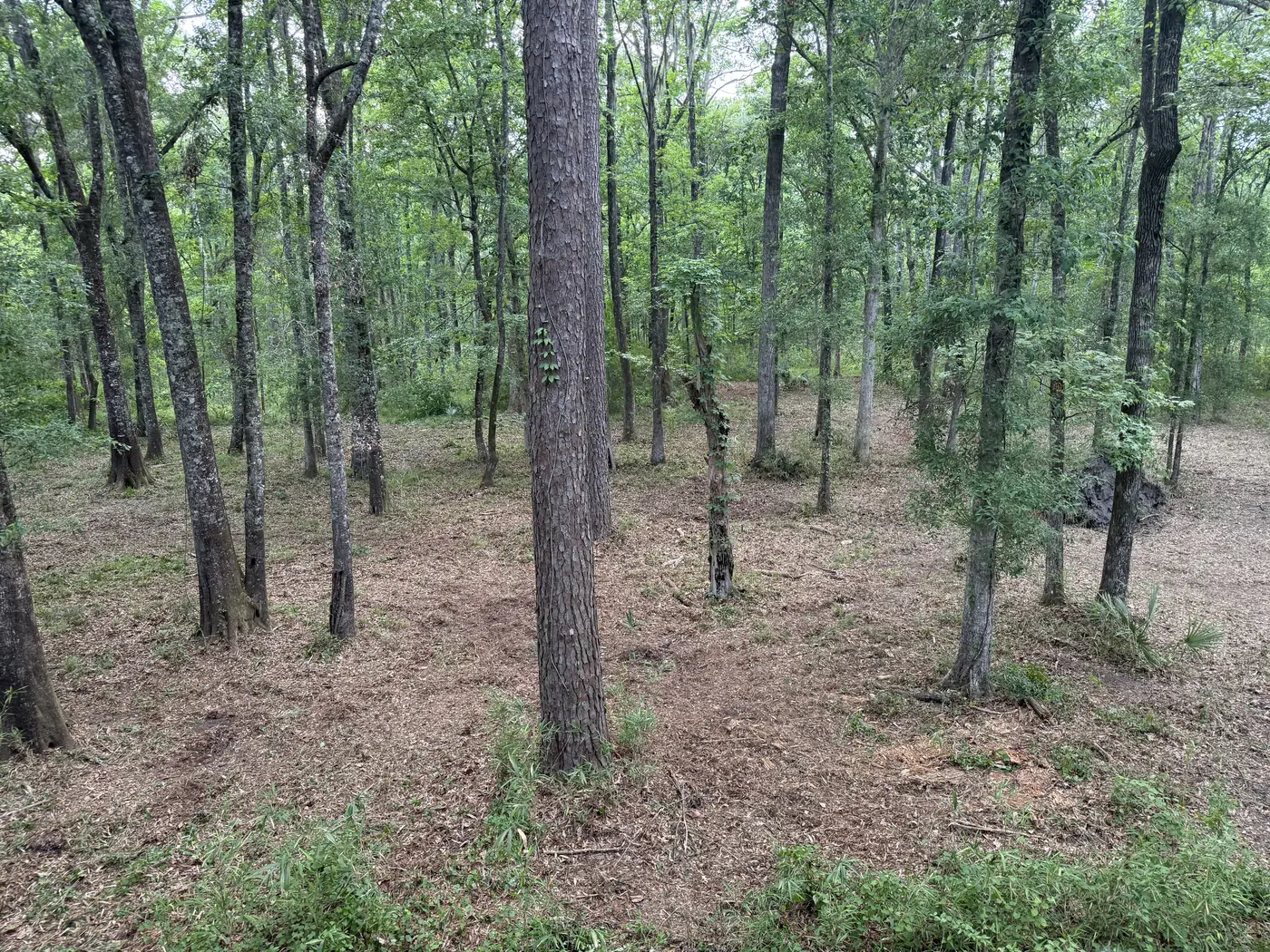
Forestry mulching vs. traditional land clearing: which one does your Lowcountry property need?
For most overgrown ground in the South Carolina Lowcountry, forestry mulching is the cheaper, faster, gentler choice: one tracked machine grinds brush and small trees into mulch that stays on site — no burn piles, no debris trucks, no bare dirt washing toward the marsh. Traditional bulldozer-and-excavator clearing costs more and disturbs more, but it does what mulching cannot: pull stumps, grub roots, and prepare ground for construction. The right answer depends on what the land is for.
Here is the full comparison, including the cases where we would honestly tell you not to hire us.
The two methods, in plain terms
Forestry mulching uses a tracked machine with a rotating drum head that chews standing vegetation — brush, vines, saplings, small trees — into wood chips right where it grew. The chips stay on the ground as a mulch layer. Stumps grind down close to grade; roots and topsoil stay in place. One machine does the whole job.
Traditional land clearing is dirt work: a bulldozer or excavator pushes vegetation over, roots and all, stacks it into piles, and the piles either burn or leave on trucks. The ground comes out bare and workable — and disturbed. It usually involves more than one machine and always involves debris handling.
Neither is “better.” They are different tools for different end states: mulching produces usable green land; conventional clearing produces construction-ready dirt.
Cost: why mulching usually wins on brush
The price gap is mostly a debris story. In conventional clearing you pay to cut the vegetation, pay again to pile it, and pay a third time to burn-sit or haul it — trucks, dump fees, extra machine hours. Mulching converts the same vegetation into ground cover on the spot, so the second and third payments never happen.
On the dense small-stem growth that takes over Lowcountry ground — wax myrtle, sweetgum regrowth, privet, smilax tangles, volunteer pine — mulching is usually the cheaper acre. As stems get bigger the math shifts: past roughly six inches the mulcher slows, past ten it is generally the wrong tool, and genuinely big timber belongs to a logging or tree-service crew before either method finishes the ground.
Every honest quote in this business starts with a walk of the property, because density, stem size, and access swing the price more than acreage does. Anyone quoting a firm number over the phone is guessing with your money.
Stumps and roots: the real dividing line
Ask one question about your project and the method usually picks itself: do the stumps have to come out of the ground?
If the answer is no — you want pasture, trails, sight lines, hunting ground, a walkable woodlot, a field that mows — mulching wins. Stumps ground an inch or two down disappear under grass and mulch, roots keep holding the soil, and the land greens back over a season.
If the answer is yes — a house pad, a septic field, a pond, a driveway cut — you need excavation, because extraction and grubbing are exactly what an excavator exists to do. The smart sequence on many builds is both: mulch the whole parcel cheaply to open it up and pick the true footprint, then bring dirt equipment in for just that footprint.
Wet ground, sandy soil, and the marsh next door
This is where the Lowcountry stops being a generic clearing market. Our soil is sandy, our ground is flat and low, and much of it drains toward a creek, a blackwater river, or the marsh itself.
Strip a parcel bare here and the first serious thunderstorm starts moving your topsoil — into the ditch, the pond, or the neighbor’s ground. Scraped sites need silt fence, seeding, and luck with the radar. A mulched parcel skips the problem: the root mat never leaves, the chip layer blankets the surface, and the soil stays where the deed says it is.
Softness matters too. Tracked mulchers float over ground that wheeled and heavy dirt equipment would rut or bog, which is why so much clearing near the wet edge here is mulcher work by default. The honest limit still exists: saturated bottomland should wait for the dry months, whoever you hire.
Trees worth keeping — and trees you’re not allowed to lose
Selective clearing is mulching’s quiet superpower. The machine works around the live oaks, the good pines, the dogwoods — grinding the junk growth between and beneath them — and the property comes out looking managed, not logged. A dozer blade does not do subtle.
In this region that is also a legal matter: many Lowcountry jurisdictions protect grand trees, most famously the big live oaks, and taking one out without sign-off gets expensive fast. A selective method that treats your best trees as fixed points keeps both the property’s character and its paperwork clean. We flag anything protected or borderline at the walk-through, before a track turns.
When traditional clearing is honestly the right call
We are a mulching outfit, and we will still send you to an excavator when the job says so:
- Building pads and septic systems — stumps and roots must come out; that is grubbing, not grinding.
- Grade changes, ponds, ditches, driveways — reshaping ground is dirt work, full stop.
- Big timber — a stand of mature trees needs a logger or tree service first; a mulcher is for what grows back after, and for everything smaller.
- Land that must be bare dirt tomorrow — mulch is a finish, and if a project spec says “stripped,” mulching is the wrong finish.
The reverse is just as true. If the goal is a field you can mow, woods you can walk, lanes you can hunt, or a parcel you can finally see before you plan it — grinding it in place is faster, cheaper, and far kinder to Lowcountry ground than pushing it into piles.
The bottom line for Lowcountry landowners
Match the method to the end state. Mulching turns overgrown ground into usable green land — cheapest on brush and small stems, gentle on soil that wants to wash, selective around the trees that make a property worth owning. Traditional clearing turns land into a construction site — the right and only choice when stumps, roots, and grade have to change.
If your ground is somewhere between those answers, walk it with someone who runs the machine and will tell you plainly which acres are which. That walk — and the written estimate that comes out of it — is free from us, anywhere in the Charleston-to-Beaufort Lowcountry: land clearing for the whole-parcel picture, forestry mulching for the method itself, or (843) 696-7162 for the conversation.