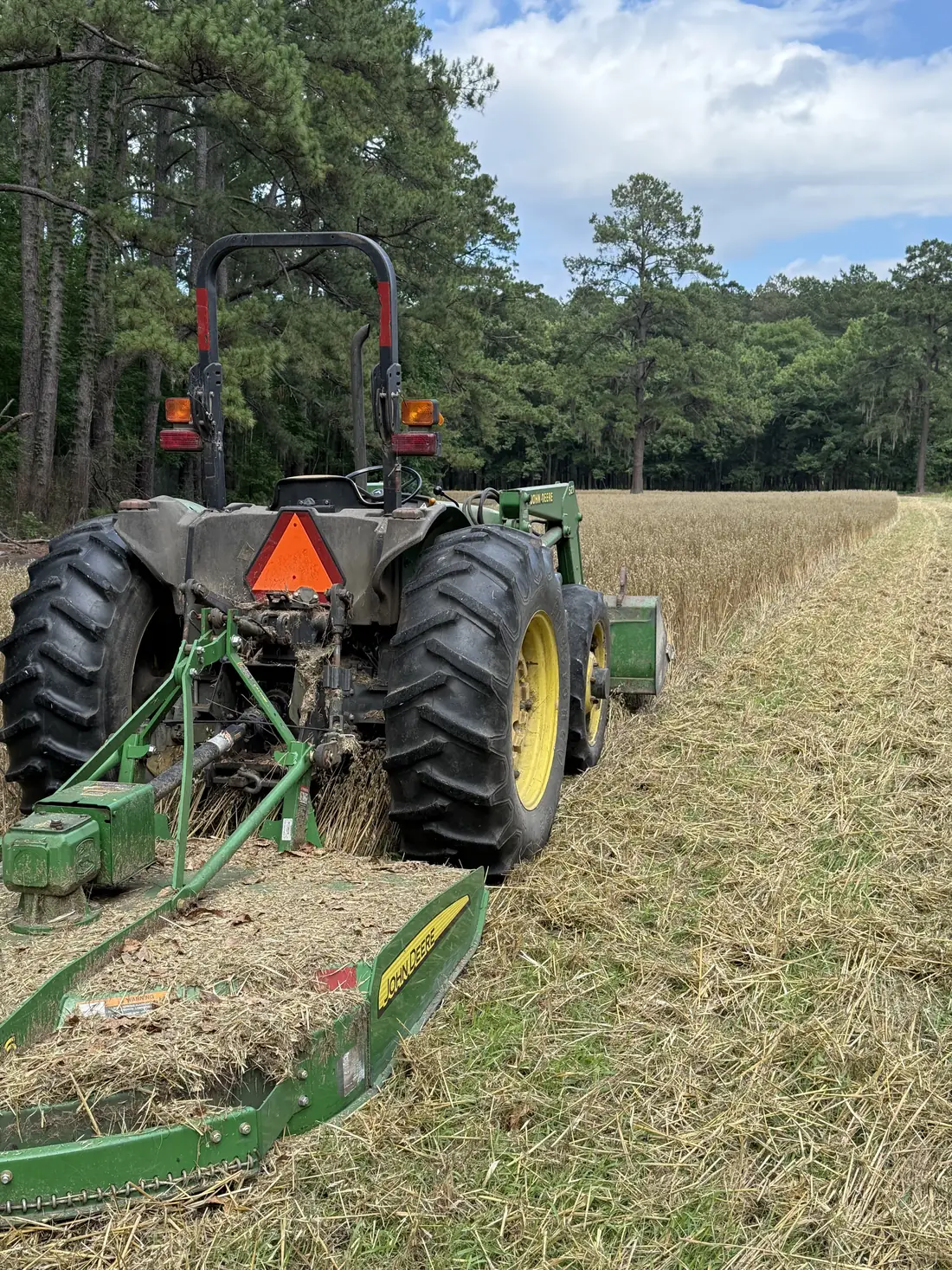
Bush hog or forestry mulcher: which does your land need?
Stem size decides it. A bush hog mows grass, briars, and saplings up to about thumb thickness at maintenance prices; a forestry mulcher grinds the woody growth past that, up to real small trees, at reclamation prices. Under the line, hogging is the honest cheap answer. Past it, forcing the hog just wrecks equipment and postpones the mulcher.
Both machines live on our trailer - bush hogging behind the tractor, the mulcher on the tracked machine - so this is a field guide, not a sales pitch. The walk-through decides which your ground gets, and most Lowcountry properties honestly need some of each.
The two machines, side by side
| Bush hog | Forestry mulcher | |
|---|---|---|
| What it is | Heavy rotary mower behind the tractor | Toothed drum on a tracked machine |
| Eats | Grass, dog fennel, briars, saplings to ~thumb size | Woody growth and brush up to small trees |
| Leaves | Cut stubble that greens back | Chip layer that suppresses regrowth |
| Pace | Acres per day on open ground | Deliberate, heavier passes |
| Job | Maintenance | Reclamation |
| Price | Mowing rates | Real machine-time rates |
The costly mistake runs one direction: hiring the mower for mulcher ground. A rotary cutter forced through wrist-thick sweetgum splinters stems into spear stubble, punishes the tractor, and leaves roots primed to come back thicker - a season of savings, then the mulcher anyway.
How to read your own ground
Grab stems. Anything you can snap by hand or fold underfoot is hog territory no matter how tall and dramatic it looks - head-high broomsedge mows easily. Anything you would want loppers for has crossed over: volunteer sweetgum and pine, myrtle gone woody, the young thicket look. Years since the last cut is the shortcut: one or two seasons usually stays mowable here, three grows woody stems, and five is a mulching job wearing a field’s name.
The Lowcountry runs this clock faster than owners from anywhere else expect. Long, wet, warm seasons are why a maintenance rhythm is cheap insurance on this coast - and why pasture reclamation, the both-machines job that grinds the woody growth and then restores the mowing surface, is one of our steadiest calls.
What the money actually buys in each case
Bush hogging money keeps a field being a field: an annual or twice-yearly pass at the low end of the price range, timed to the growth and the ground. Mulching money changes what the ground is: thicket back to open, with a chip layer slowing the regrowth while the land settles into being maintainable again. They are different products, and the honest sequence for slipped ground is always the same - reclaim once, then maintain forever, because the maintenance pass costs a fraction of ever reclaiming again.
On hunting tracts the two run as a system: the mulcher opens understory and stand zones, the hog holds lanes, plot edges, and fields in the tender growth game feeds on. That rhythm - reclaim, then rotate - is exactly how our own family ground in the Basin gets managed, which is where every recommendation we make was field-tested first.
Get both priced in one walk-through
Send photos or let us walk it: these acres hog, that section mulches, and the written estimate prices each honestly so you choose with real numbers. Free, specific, and scheduled straight. Call or text (843) 696-7162 or start at the contact page. The only expensive machine is the wrong one.